
Funding models for community-based internet service providers
By Adriano Belisário, Bruno Vianna, Hiure Queiroz and Thiago Novaes Publisher: APCNews 17 August 2018Brazil still has a wide digital divide: more than 30% of households are not connected to the internet. According to a recent research study, the lack of experience in using technology and the high prices imposed by companies are amongst the main reasons why households are disconnected. Most of those with no access live in the countryside – less than half of households in rural areas are connected – or in low-income neighbourhoods in places that are of no interest to the main commercial internet service providers (ISPs). Connections would come at a premium cost, as maintenance and installation costs are much higher for remote localities – and these are exactly the clients who cannot afford premium service.On the contrary, people need cheap, not-for-profit connectivity suited to their needs and financial possibilities. As in many countries, there are few companies in Brazil providing access to telecommunication, in contrast to the precarious conditions of autonomous initiatives or local-based ISPs. The scenario changes dramatically within different regions – from wide uninhabited stretches of the Amazon, hundreds of kilometres to the nearest point with electricity, to the overcrowded slums in big cities.In an effort to counter this situation, Coolab was founded at the beginning of 2017 as a cooperative/laboratory to provide support, capacity building and financing for community telecommunications infrastructure. Considering that both analogue and digital technologies share the potential of empowering hard-to-reach communities, our research focuses on the development of multiple models of community networks that can be experienced through ethnic, experimental and social uses.What are the values most important for given communities? What would be considered a fair fee? What culture will be experienced online – their own music and language? Or will all neighbours indulge in Instagram? Coolab members believe that connecting people should be understood as a need to improve local production and to provide global/local communication as a fundamental human right.Improving our digital autonomy, reducing the risks of surveillance and the concentration of power in cyberspace, demand conversations about infrastructure and financing models. At Coolab, we believe in and work actively with free software and open source knowledge to achieve it. Software, knowledge and spectrum should be regarded as a common resource. In this sense, we also advocate for a “free spectrum” paradigm regarding spectrum management policies. In this article, we will describe and evaluate different funding models for community-based ISPs.
External funding modelThe members of Coolab have been working on projects and initiatives related to autonomous telecommunication infrastructures, mesh networks and movements like free/community radio for a long time. We used to deploy networks using grants offered by NGOs and international foundations or research grants from universities. In cases like these, after presenting the idea to the local community, someone would gather together a group to write a project proposal and look for funds in order to buy the equipment and other resources needed. After the installation was done, the community would take care of the network on their own.In 2015, the rural hacklab Nuvem obtained a grant from Commotion to create a Wi-Fi mesh and GSM network in the community of Fumaça, in the state of Rio de Janeiro, with about 1,000 inhabitants. This is a very relevant case, since it laid the ground for what would become Coolab's methodology, combining a week-long immersion of visiting volunteers to start the process with a barn-raising activity within the community. But the financing provided no method for the sustainability of the network: the grant funds were used to provide the community with a cost-free internet, with no conditions except for an agreement that they should do their own maintenance as and when needed later.Beyond Nuvem, other projects in which the Coolab team was involved were the local networks and intranets installed in Casa dos Meninos (São Paulo, 2016); community-based ISPs in Campos city (Rio de Janeiro, 2008-present), the Kalunga Afro-Brazilian community (Goiás, 2017-present), and the use of digital radio to broadcast data using short waves in the Amazon rainforest (2016-present).This model (fully supported by one funder) had some advantages, but we also faced some problems. On the one hand, it is easier and cheaper for the community because people can receive all financial and technical support from an external group. In these cases, there is no hesitation from the community to embrace the project, since there is no financial commitment. Hence the process happens in a very fast and straightforward manner, and sometimes it will be the only option for extremely poor neighbourhoods or villages. It dramatically reduces costs, especially at the beginning of the project, a step where expenditure on equipment is concentrated, for instance. As mentioned before, this is a very important factor, since our focus is to work mainly with low-income communities.But in the long run, these communities are left on their own with no system in place to collect the much-needed funds to eventually replace equipment, pay an expert for maintenance, or even cope with a sudden increase in the backhaul costs. They become dependent on external supporters or fundraising. The long-term sustainability can be compromised, especially if the local organisation or key persons aren't engaged or don't have enough resources not only to keep the infrastructure running but also to provide good interfaces (physical and digital) to end-users.That is the reason that led Coolab to define itself as a laboratory, to experiment with other models of network sustainability. We believe that there is always a network that can be built with the resources a community can afford. Therefore, from the very beginning, we provide a platform for the community to collect monthly micro funds from their users. And although we finance the acquisition of the equipment and the immersion costs, these must be paid back – even if it takes years – so that we can make new installations in more places.
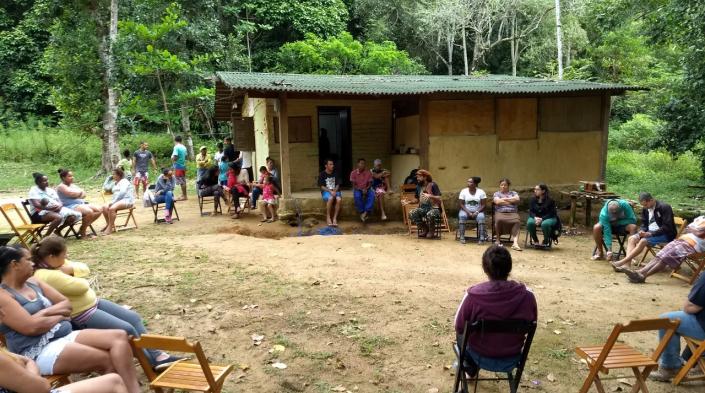
The model of the self-sustainable and circular economy for communitiesWe started officially as a group at the beginning of 2017, boosted by winning the award for the "most novel" initiative in the Mozilla Equal Rating Innovation Challenge. The prize made it possible for us to issue a public open call directed to communities in need of connectivity, and we received more than 50 submissions from all regions of the Brazilian territory.Those submissions were made by NGOs, residents’ associations and other initiatives that could work as “anchor tenants” for our efforts in the communities. Amongst these, five were selected to start building community-owned and managed networks. We took equipment and spent the time to experiment with a methodology that could count on the commitment of the community leaders and engaged with the wider community, such as governmental and non-governmental organisations, universities, schools and independent researchers. A partnership with the Rosa Luxemburg Foundation, for instance, allowed us to create two more networks.Finally, our technical visit for the installation process would take the form of a week-long immersion in which the neighbourhood is invited to participate in the learning experience and assumes the responsibility for building autonomous self-maintained communications. Our first goal was to establish self-managed telecommunications infrastructures. In some cases, this meant that locals who used to have to walk several kilometres to send a message could now do it from their homes; in another place, a group of young people became so involved with the idea of community networks that they were able to replicate the process in a nearby village.We're currently supporting seven different networks in four different states of Brazil. The estimated cost depends on many factors, like the topology, social aspects of each territory or even the US dollar exchange rate. But usually it doesn't go beyond USD 8,000.
| Community | State | No. of nodes | Network status |
| Monteiro Lobato | São Paulo | 12 | Running |
| Quilombo Camburi | São Paulo | 8 | Running |
| Aldeia Guarani | São Paulo | 7 | Running |
| Favela da Maré | Rio de Janeiro | 3 | Maintenance |
| Aldeia Velha | Rio de Janeiro | 5 | Maintenance |
| Juruti Velho | Pará | 12 | Under study |
| Rio Largo | Alagoas | 10 | Deploying now |
In Monteiro Lobato, for instance, we are seeing a growing interest from people in how the communication technologies work since the plans to create a community-owned network started. Some people asked to join the network we're supporting, while others started a massive campaign demanding better services from the private ISP currently operating there. Some of them also bought their own antennas to share with their relatives or neighbours. After that, the company reduced the prices of the plans available in this region of São Paulo and installed optical-fibre infrastructure in order to avoid the migration of its users.This fact strengthened ties in the group dedicated to deploying a community-based network. They realised that the main reason was not actually the lower cost, but to create their own service with a local workforce or to acquire more knowledge about how the internet works. This interest was very common among youths: some of them who were involved with drug dealing in the past are now working to provide maintenance for the community network.Recently, the local association that manages the network created a technical council aimed at offering workshops and deliberate over technical decisions regarding the community provider. To fight back against some rumours about the initiative, a women’s group created interactive posters to invite people to regular meetings and published a zine about how the internet works.